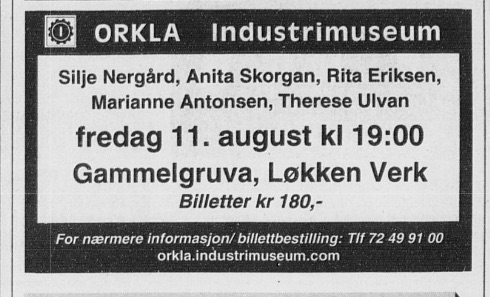
advertisement in Adresseavisen, Friday August 9. 2000
| Translation by Dag Sirnes: ORKLA Industrial Museum
Silje Nergaard, Anita Skorgan, Rita Eriksen, Marianne Antonsen, Therese Ulvan Friday, August 11 at 7 p.m. Gammelgruva (*), Løkken Verk Tickets NOK 180 For further information / ticket booking: tel. 72 49 91 00 orkla.industrimuseum.com * Gammelgruva = The Old Mine |
| Translation by Dag Sirnes: Background info about Gammelgruva at Løkken Verk English translation of description from the Norwegian website (with nice photos): https://www.lokkenverk.no/gammelgruva GAMMELGRUVA The local community Løkken Verk has been built around 300 years of mining. The ore in the Løkken field was found in 1652 and the mines put into operation in 1654. Later it turned out that this was one of the world's largest deposits of copper-containing pyrite. For the first 250 years, copper was the main product, followed by a period in which both copper and sulfur were extracted. In recent years of operation, copper, zinc and silver were the sales products from the mines at Løkken. The mine was closed on July 10, 1987, after 333 years of operation. The vein of the ore is about four kilometers long. It starts from the gate of Gammelgruva (The Old Mine) and goes deep and far inland in the mountains to where the Astrup mine-shaft is located at Bjørnli. At Astrup, the ore has been followed down 800-900 meters. A visit to Gammelgruva provides insight into mining in older times. This old mine is also called the "Cathedral of Labor and Wear". Here the miner had a daily battle against the hard ore to keep himself and his family alive. The ore was taken out by so-called firing. Large bonfires were lit up against the rock wall so that the rock cracked. When the fire was extinguished and the smoke was vented, the miner used a hoe and broke loose rocks where the rock had cracked. Then the ore was carried up and out, while firewood was carried in and down. Slowly the mine got bigger. The largest room you as a tourist enter is called the Fagerli Hall. It has a floor area of 1,300 square meters and a ceiling height of 15 meters. Here you really get the feeling of being in a cathedral. As a concert hall, the Fagerli hall is completely unique, with a rare fine acoustics. A number of well-known artists from home and abroad have held concerts here. The Fagerli Hall has also been an arena for theater productions. It was not until the 20th century that mining on an industrial scale took off. The architect Christian Thams started the Orkla Mining Company, and started one of the largest industrial developments in Norway at the time. Production buildings, power plants, offices, shops and homes were necessary in a modern industrial society. It was in this connection that the Thamshavn railway was built, to more efficiently transport the ore to Orkanger and the smelter that was established there. After a short time, however, Thams gave up and traveled abroad, but what he started grew to become one of the country's most solid companies, and is the forerunner of today's Orkla Group. |